

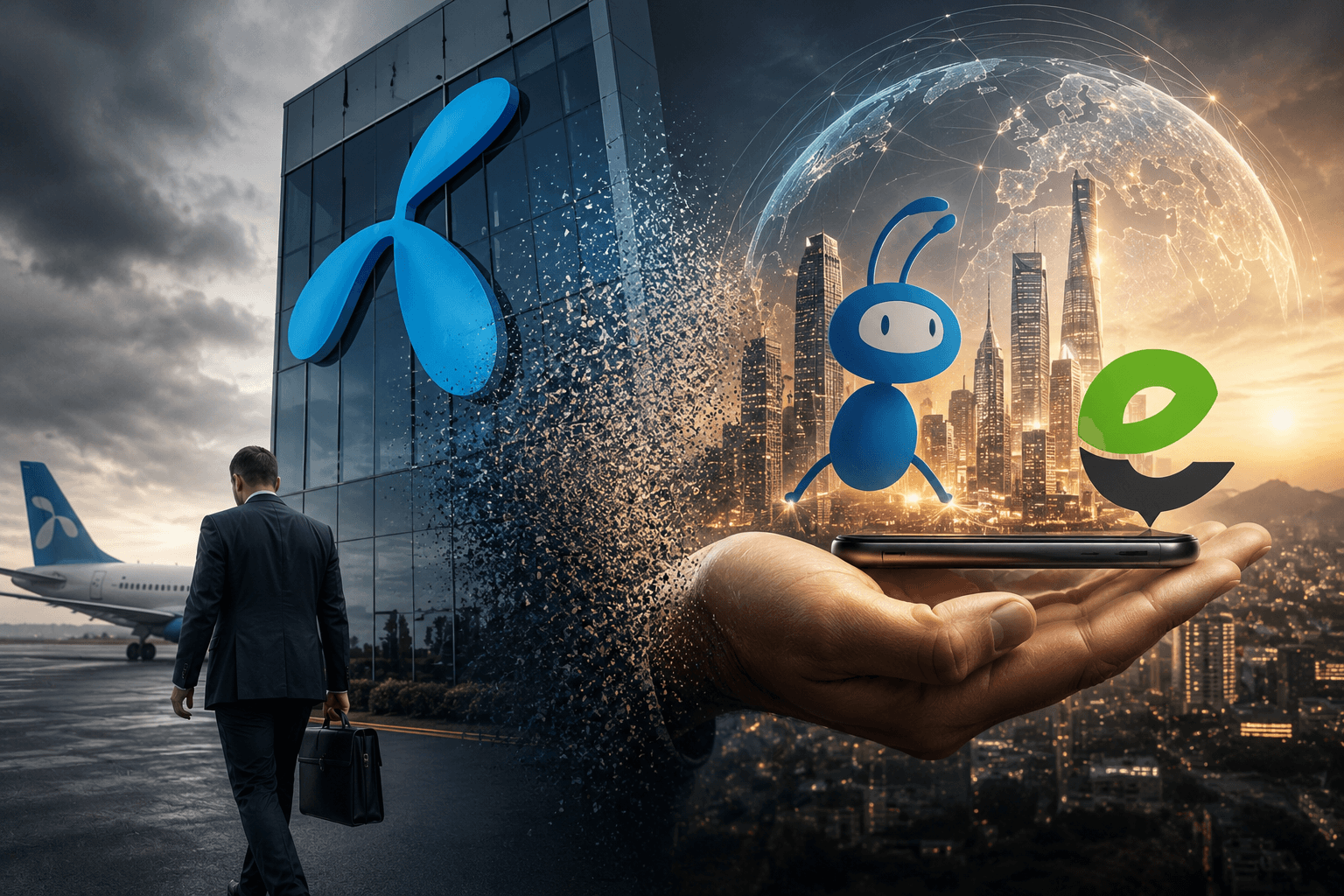
Everyone is talking about Telenor leaving Pakistan. That is the wrong conversation.
Yes, Telenor is exiting. The Norwegian telecom giant has confirmed it is selling its 55 percent stake in Easypaisa, Pakistan’s largest digital bank, and is working with Citigroup to manage the transaction. This comes after Telenor already exited the telecom side of its Pakistan operations in a deal worth approximately $490 million. The departure of one of Pakistan’s most prominent foreign telecom operators is a headline. It is also, in the broader picture, a sideshow.
The company buying control of Easypaisa is not a struggling local investor picking up a distressed asset. The remaining stakeholder already sitting at the table is Ant Group, the financial technology arm of Alibaba, and the operator of Alipay, the single largest payments platform on earth. Understanding what that means for Pakistan’s financial future requires looking past the Telenor exit and asking a more important question: what does Ant Group do with full control of a fast-growing digital bank in a market of 240 million people?
Easypaisa Is Not a Distressed Asset
The narrative around Telenor’s exit has led many commentators to frame Easypaisa as something being abandoned. The financial data tells a completely different story.
Easypaisa posted a pre-tax profit of Rs3.66 billion in the first quarter of 2026. That is 4.4 times what it earned in the same quarter of the previous year. To put that in plain terms, Easypaisa is not just profitable. It is accelerating. Quarter-on-quarter growth at that rate in any financial services business, anywhere in the world, would attract serious institutional attention. In a market as large and as underpenetrated as Pakistan, it represents something more significant still.
Pakistan’s financial inclusion story is at an inflection point. A large proportion of the adult population remains unbanked or underbanked, with limited access to traditional banking services. Digital wallets and mobile money platforms have been chipping away at this gap for years, and Easypaisa has been at the front of that movement since its launch. The combination of a rapidly growing user base, expanding transaction volumes, and now a quarterly profit figure that has grown more than fourfold in twelve months creates a picture of a business that is not being abandoned by its owners. It is being repositioned.
Who Is Ant Group and Why Does This Matter for Pakistan
Ant Group is not a name that appears frequently in Pakistani financial media, but it arguably has more relevance to Pakistan’s economic future than almost any other technology company operating in the region.
Ant Group operates Alipay, which processes more transactions annually than Visa and Mastercard combined. It is the financial infrastructure backbone of China’s consumer economy and has spent the past decade methodically expanding that infrastructure into emerging markets across Southeast Asia, South Asia, and Africa. Its investments in GCash in the Philippines, bKash in Bangladesh, Wave Money in Myanmar, and Paytm in India follow a consistent pattern: identify a high-potential digital payments platform in a market with low financial inclusion, acquire a meaningful stake, and then connect that platform to Ant’s global settlement and technology network.
Pakistan fits this template precisely. It is a large, young, and digitally connected population with low formal banking penetration and a rapidly growing smartphone user base. It sits at the intersection of CPEC trade corridors and the broader Chinese Belt and Road infrastructure. And it has a diaspora population that sends enormous volumes of money home every year.
If Ant Group moves to take full control of Easypaisa following Telenor’s exit, Pakistan would not just have a new majority owner of its largest digital bank. It would have direct connectivity to the most powerful payments and financial services network on the planet. The implications of that reach well beyond mobile wallets.
The Remittances Opportunity No One Is Talking About
Pakistan receives approximately $40 billion in remittances annually from its diaspora. This makes remittance inflow one of the most significant components of the country’s external account, providing a critical source of foreign exchange that supports the rupee and helps finance the current account deficit.
Despite this scale, the remittance corridor into Pakistan remains fragmented, expensive, and inefficient for many senders. The majority of these transactions still flow through traditional money transfer operators and formal banking channels that carry high fees and slow settlement times. Digital remittance platforms have been growing but no single player has captured the corridor in the way that GCash has in the Philippines or bKash has in Bangladesh.
This is precisely the kind of gap that Ant Group has addressed repeatedly in other markets. Its global settlement infrastructure, combined with Alipay’s reach into the Chinese diaspora communities that send money to Pakistan, and its connections to partner platforms across Europe, the Middle East, and North America, creates a potential remittance solution that could fundamentally change how Pakistan receives its $40 billion inflow. An Easypaisa under full Ant Group control, connected to that global network, would be positioned to compete directly with Western Union, MoneyGram, and the informal hawala channels that still carry a substantial portion of Pakistani remittance flows.
For the Pakistani diaspora, this matters directly. Faster, cheaper, and more transparent remittance options mean more of each dollar, pound, or dirham sent home actually reaches the family it was intended for. For Pakistan’s macroeconomic position, greater formalisation of remittance flows through regulated digital channels improves the country’s foreign exchange accounting and reduces the premium on informal currency exchange.
You can read more about Pakistan’s evolving fintech landscape and the challenges facing digital payment companies in our earlier analysis on why Pakistani startups face payment processing challenges.
CPEC, Trade Finance, and the Bigger Picture
Remittances are only one dimension of the opportunity that a fully Ant Group-controlled Easypaisa would be positioned to address. The China-Pakistan Economic Corridor has created substantial bilateral trade flows between the two countries, and those trade flows require financial infrastructure to function efficiently.
Currently, cross-border trade finance between Chinese firms and Pakistani counterparts is handled primarily through traditional banking channels, which are slow, expensive, and inaccessible to many small and medium enterprises on both sides. The same digital infrastructure that Ant Group has used to facilitate trade finance across Southeast Asia’s supply chains is directly applicable to the CPEC trade corridor. An Easypaisa with deep integration into Ant Group’s settlement and trade finance systems would be uniquely positioned to intermediate these flows in a way that no existing Pakistani financial institution currently can.
For Pakistani exporters and importers working within CPEC-related industries, this represents a potential reduction in the cost and friction of cross-border transactions. For Pakistani businesses looking to access Chinese supply chains, a digital payment and credit infrastructure backed by Ant Group’s technology could open doors that traditional banking has kept closed.
What Pakistan Capital Markets and Fintech Sector Should Watch
For investors and analysts tracking Pakistan’s capital markets and fintech sector, the Telenor exit and the subsequent question of Ant Group’s next move is one of the most consequential corporate developments of 2026. Several things are worth watching closely in the coming months.
The first is the formal structure of the transaction. Easypaisa operates as a licensed digital bank under the State Bank of Pakistan’s regulatory framework. Any change in majority ownership requires SBP approval, and the terms of that approval, including any requirements around local participation, capital commitments, or operational conditions, will shape what Ant Group can actually do with the asset once the transaction closes.
The second is Easypaisa’s continued financial performance. The Q1 2026 profit figure of Rs3.66 billion is remarkable but a single quarter does not define a trajectory. If the company sustains this growth rate through the remainder of 2026, the strategic case for Ant Group’s full commitment becomes substantially stronger and the valuation of the stake Telenor is selling rises accordingly.
The third is the competitive response from Pakistan’s banking sector. Easypaisa’s growth is already putting pressure on traditional banks’ retail and consumer banking revenues. A fully Ant Group-backed Easypaisa with global payments connectivity and deep technology integration would accelerate that pressure significantly, particularly in the segments of remittances, cross-border trade, and SME lending where traditional banks have historically been slow to innovate.
Pakistan’s broader fintech ecosystem will also feel the downstream effects. A dominant, globally connected digital bank creates both competitive pressure and platform opportunity for the hundreds of startups building products and services in Pakistan’s financial technology space. Those that can build on top of or alongside Easypaisa’s infrastructure may find a more powerful distribution channel than they currently have access to. Those that compete directly with its core functions will find the challenge considerably harder.
The Correct Reading of What Is Happening
Telenor leaving Pakistan is a corporate retreat by a European telecom operator that has decided the returns available in Pakistan’s market no longer justify the capital deployed. That decision reflects Telenor’s own strategic priorities and shareholder expectations. It tells us very little about Pakistan’s economic trajectory.
What Ant Group does with the asset Telenor is vacating is the story that will define Pakistan’s digital financial infrastructure for the next decade. Ant Group is not a passive financial investor. It is an operator with a proven playbook for scaling digital financial services in emerging markets, a global settlement network of unmatched scale, and a demonstrated willingness to deploy that network wherever the conditions are right.
Pakistan’s conditions, a large and young population, rapid smartphone adoption, a major remittance corridor with no clear digital winner, a CPEC trade relationship with the world’s second-largest economy, and a digital banking sector growing at 4.4 times year-on-year profit pace, are about as right as they get.
Telenor leaving is a headline. What happens next with Easypaisa and Ant Group is the actual story. It is worth watching closely, especially for anyone tracking Pakistan’s capital markets, its fintech sector, or its broader economic integration with global trade and payments networks.
For context on how Pakistan’s broader digital economy is evolving, our coverage of EV charging stations in Pakistan and Pakistan’s payment processing landscape offers useful background on the infrastructure and policy shifts shaping the country’s technology economy in 2026.
Key Facts at a Glance
Telenor is selling its 55 percent stake in Easypaisa digital bank and is working with Citigroup to manage the sale. Telenor previously exited Pakistan’s telecom operations in a separate transaction worth approximately $490 million. Ant Group, the operator of Alipay and the financial technology arm of Alibaba, already holds the remaining stake in Easypaisa. Easypaisa reported a pre-tax profit of Rs3.66 billion in Q1 2026, which is 4.4 times the profit it recorded in Q1 2025. Pakistan receives approximately $40 billion in annual remittances with no dominant digital platform currently controlling that corridor. Ant Group has previously made strategic investments in GCash in the Philippines, bKash in Bangladesh, Wave Money in Myanmar, and Paytm in India. Any change in Easypaisa ownership structure requires approval from the State Bank of Pakistan under its digital banking licensing framework.
According to the State Bank of Pakistan’s digital banking framework, digital bank licensing in Pakistan is subject to ongoing regulatory oversight including capital adequacy requirements and ownership change approvals. The Financial Times and Bloomberg have both reported on Ant Group’s continued expansion strategy in South and Southeast Asian digital payments markets as part of its post-regulatory recovery growth phase in 2025 and 2026.
This article is based on publicly available information and reported facts. All financial figures referenced are sourced from corporate disclosures and verified reporting. Insight Pakistan does not hold any investment position in the companies referenced.
