

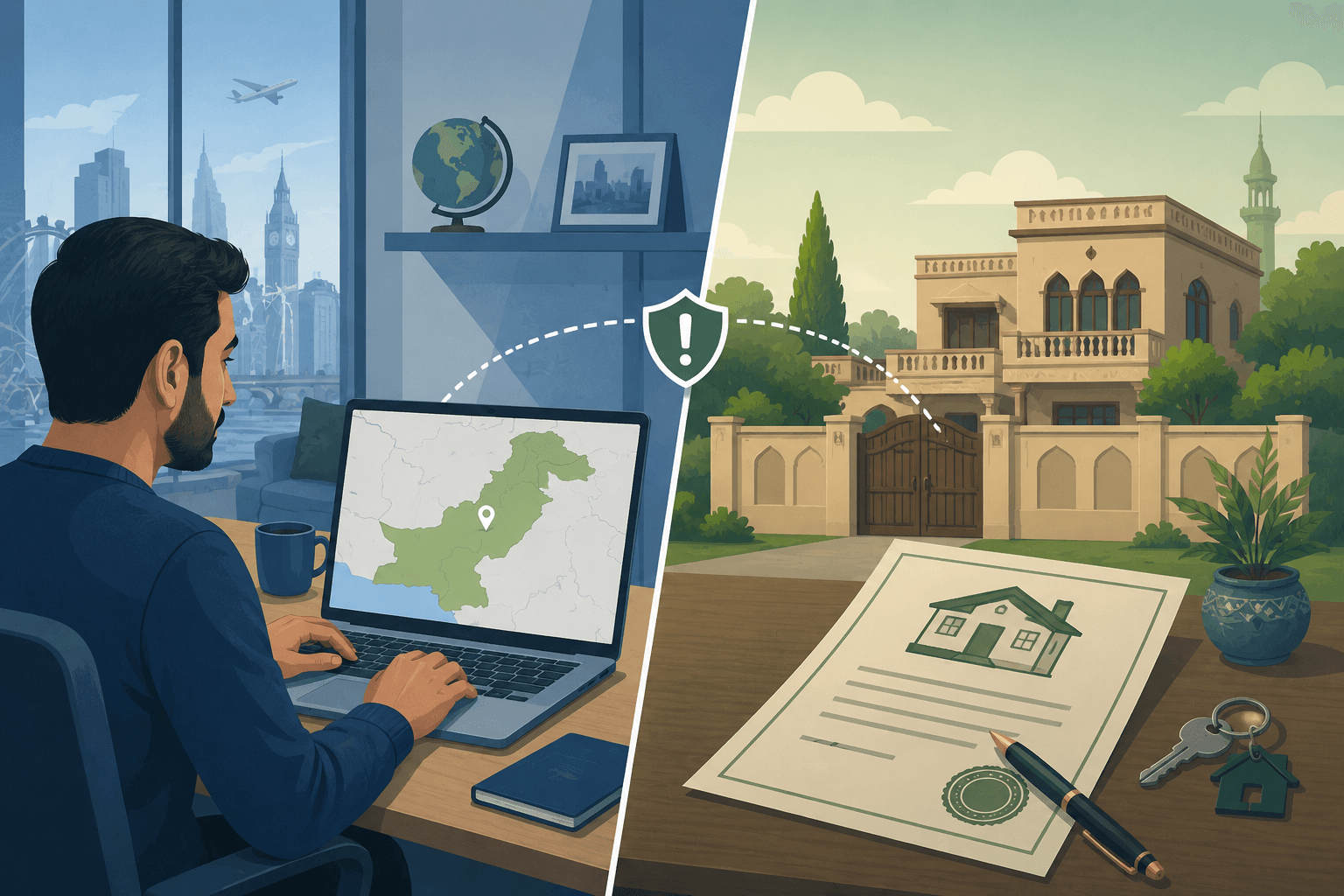
Every year, thousands of Pakistanis living in the United Kingdom, United States, United Arab Emirates, Saudi Arabia, Canada and Australia send hard earned money home to invest in property. For many, it is the single largest financial decision of their lives. Yet according to official records from the Overseas Pakistanis Commission Punjab, more than 7,814 fraud complaints have been filed by overseas Pakistanis, covering cases involving losses that range from a few hundred thousand rupees to hundreds of millions. A significant portion of those complaints involve property fraud.
The painful reality is this: overseas Pakistanis are the preferred target of property fraudsters in Pakistan. Scammers know that someone living abroad cannot visit frequently, cannot verify documents in person, and often relies on relatives, agents or online advertisements when making major financial decisions. That combination makes them far easier to deceive than a local buyer who can walk a site and check a record in person.
This guide is written for every Pakistani living abroad who wants to invest in property back home safely and legally. It covers the exact fraud methods currently being used against overseas buyers, the government portals and legal tools that protect you, how to issue a Power of Attorney without putting your property at risk, what tax treatment you receive as an overseas buyer, and what to do if something has already gone wrong.
Why Overseas Pakistanis Are the First Choice of Property Fraudsters
Property fraud in Pakistan does not target any single city or income group, but its most sophisticated schemes are built specifically around overseas buyers. A local buyer in Lahore or Karachi can visit a plot, cross check land records at the local patwari office or online portal, speak to a lawyer in person, and observe a neighbourhood with their own eyes before committing a single rupee. An overseas buyer in Birmingham or Dubai cannot do any of these things without planning a dedicated visit home, which most families abroad can only manage once or twice a year at best.
Scammers exploit this gap methodically. They approach overseas buyers through WhatsApp groups, Facebook real estate pages, YouTube advertisements, and phone calls to relatives in Pakistan who are then encouraged to vouch for a deal. The pressure of investing from a distance, combined with the emotional pull of building something back home for one’s family, creates exactly the kind of urgency that fraudsters depend on.
According to a 2026 investigation, one of the most striking examples came to light in May 2026 when investigators found that 42,000 files had been issued for only 6,000 actual plots in a housing society near Islamabad, raising allegations of organised fraud against buyers, with overseas investors believed to be among the most affected. Cases like this are not rare exceptions. They are part of a pattern.
Understanding why you are targeted is the first step toward protecting yourself from becoming a victim.
The Six Most Common Property Scams Targeting Overseas Buyers

1. Fake Housing Society Files
This is the most widespread scam facing overseas Pakistanis in Pakistan’s property market. A developer or agent sells plot files in a housing society that either does not exist at all, has not received approval from the relevant development authority, or has issued far more files than there are actual plots available. The buyer pays in full, receives a printed file with a plot number and a society map, and discovers years later that their plot number does not correspond to any real piece of land on the ground.
Before paying anything toward any housing society, verify the society against the official approved scheme list of the relevant authority. In Punjab, this is the Lahore Development Authority (LDA) for Lahore properties, or the relevant District Development Authority for other Punjab cities. In Islamabad, it is the Capital Development Authority (CDA). In Karachi, it is the Sindh Building Control Authority (SBCA). Each of these bodies maintains and regularly updates a list of approved and blacklisted housing schemes on their official websites, which can be accessed from anywhere in the world.
2. Double Selling of the Same Plot
Double selling involves a seller generating separate documentation to sell the same plot to two or more buyers simultaneously. It is made possible when ownership is unclear or when a buyer delays formal registration after paying. For overseas buyers who often finalise deals remotely and leave the physical paperwork to a relative or agent, this is a particularly acute risk. Two buyers can both hold documents for the same property, and the legal battle to resolve it can drag through Pakistani courts for years.
The defence against double selling is immediate registration. Once a deal is finalised, the property must be transferred and registered in your name at the relevant land record office without any delay.
3. Caretaker Fraud on Your Existing Property
If you already own property in Pakistan and have someone managing it for you, that property itself can be sold without your knowledge. Caretakers in some cases approach agents, pose as the owner, and sell the property at a price below market value to attract a quick buyer. This particular fraud targets overseas Pakistanis who have left residential property vacant in Pakistan for extended periods.
The safest response is regular remote monitoring of your property’s official ownership record through the relevant provincial land record portal, combined with physically trusted family present near the property who can flag any unusual activity.
4. Misuse of Power of Attorney
A Power of Attorney, called Mukhtar Nama in Pakistani legal language, is a document that authorises another person to act on your behalf in a specific legal or financial matter. It is an essential tool for overseas Pakistanis who cannot be physically present in Pakistan to sign documents. However, when issued carelessly, a Power of Attorney becomes one of the most powerful instruments a fraudster can use against you. A General Power of Attorney in particular, if granted to the wrong person or even to a trusted relative under pressure, can give that person full legal authority over all your property in Pakistan. The section below on issuing a safe Power of Attorney covers this in full.
5. Encroached or Disputed Land
Another common fraud involves land that is already under a legal dispute, subject to a court injunction, or even physically occupied by another party. Sellers present fraudulent title deeds or deliberately conceal ongoing litigation before completing the sale. For a buyer abroad who cannot conduct a site visit or easily access court records, this can be impossible to detect without professional legal assistance.
Land in rapidly urbanising areas on the outskirts of Lahore, Karachi and Islamabad, where agricultural land is being converted to residential use, carries a particularly elevated risk of encroachment and dispute. A lawyer-conducted title search is the only reliable protection against this type of fraud.
6. Advance Payment and Disappear
The simplest scam requires no documentation at all. A fraudster advertises a property online at an attractive price, collects a token or advance payment, and disappears once the transfer is received. These advertisements appear on legitimate looking websites, Facebook groups and Instagram pages that mimic real estate companies with professional branding and fake reviews.
Never pay any advance without first verifying the seller’s identity in person through a trusted representative, and without confirming property ownership through the official land record portal.
How to Verify Any Property Before You Pay
Verification is not optional. It is the single most important step in protecting yourself as an overseas buyer, and every verification method below can be used from any country in the world.
Punjab Land Record Authority (PLRA)
For any property in Punjab province, the Punjab Land Record Authority portal at plra.punjab.gov.pk allows you to verify the current legal ownership of any piece of land using the Khasra number, Khatauni number, or the seller’s CNIC. The result tells you who is the registered owner of that land according to the official government record. If the seller’s name does not appear as the owner in the PLRA database, stop the transaction immediately regardless of what documents they are showing you.
External link: Punjab Land Record Authority verification portal at plra.punjab.gov.pk
Sindh Land Records Authority
For properties in Sindh, the Board of Revenue Sindh maintains provincial land records. The Sindh Land Records Authority (SLRA) is progressively digitising records, though coverage in some rural areas remains partial. For Karachi specifically, the City Survey office records are the most reliable reference for urban property verification.
Capital Development Authority (CDA) for Islamabad
For properties and housing societies in Islamabad, the CDA website at cda.gov.pk maintains the definitive list of approved schemes and plot files. Any scheme that is not on the CDA approved list is operating without legal authority.
External link: CDA approved housing schemes list at cda.gov.pk
Check LDA Approved Schemes for Lahore
For Lahore specifically, the LDA website at lda.gop.pk publishes an updated list of approved housing schemes. This is the most searched resource by Lahore property buyers and is freely accessible from abroad.
External link: LDA approved housing schemes at lda.gop.pk
Engage a Property Lawyer for Title Search Due Diligence
For any purchase above Rs 5 million, the cost of hiring an independent property lawyer to conduct formal title search due diligence is negligible compared to the legal and financial protection it provides. A lawyer will check the complete chain of title transfers, verify that no court injunctions or legal encumbrances exist on the property, and confirm that property taxes are clear. This is standard practice in every serious property market globally and should be non-negotiable for overseas buyers who cannot be present in Pakistan.
Pakistan’s real estate sector is currently seeing strong recovery momentum driven partly by record overseas remittances. As we covered in our article on the NEC Annual Development Plan for fiscal year 2025-26, the government’s policy direction for infrastructure and housing has been central to this recovery, which also means more housing schemes are launching and the risk of unverified schemes entering the market is higher than ever.
How to Issue a Power of Attorney Safely From Abroad
The Power of Attorney is where many overseas Pakistanis unknowingly create their own vulnerability. Issuing it correctly using official channels takes only slightly more effort than the informal route, and provides substantially greater legal protection.
Use NADRA’s Official Online POA System
NADRA, in collaboration with the Ministry of Foreign Affairs, has developed an automated digital system specifically for overseas Pakistanis to issue a Power of Attorney without travelling to Pakistan. The system is centrally managed by NADRA and accessible at poa.nadra.gov.pk. Overseas Pakistanis can apply through this portal and, in most cases, complete the process without physically visiting a Pakistani embassy.
External link: NADRA Online Power of Attorney portal at poa.nadra.gov.pk
Before submitting an application through this system, the applicant must be an overseas Pakistani with a valid identity document such as a CNIC, NICOP or POC. Valid identity documents are also required for each witness and for the attorney being appointed. Documents processed through the NADRA online system are accepted by land record offices, courts and government departments across Pakistan, and the digital audit trail they create makes forgery far more difficult than the older manual attestation process.
Always Issue a Special Power of Attorney, Not a General One
A Special Power of Attorney limits authority to a single specific task, for example completing the transfer of one specific plot at a specific address. Once that task is completed, the authority it grants ends automatically. A General Power of Attorney grants broad authority over all your financial and legal affairs in Pakistan. Unless you are appointing an immediate family member for a clearly defined and time-limited reason, never issue a General Power of Attorney for property matters. This single precaution has prevented more fraud against overseas Pakistanis than any other measure.
Monitor Your Ownership Record After Issuing a POA
After issuing any Power of Attorney, use the PLRA portal for Punjab properties to verify that your name continues to appear as the registered owner. Check this every three to four months. If you notice an ownership transfer that you did not authorise, you have both the timestamp and the documented record to take immediate legal action with clear evidence.
Tax Treatment for Overseas Pakistani Property Buyers
One area that many overseas buyers are unaware of is the tax advantage they hold as non-resident Pakistanis. Under Section 236K of the Income Tax Ordinance 2001, advance tax is collected from property buyers at the time of transfer. Standard buyers who are not Active Taxpayers List (ATL) filers pay higher non-filer tax rates, which can be substantial on higher-value properties.
However, FBR policy confirms that overseas Pakistanis holding a NICOP or POC who qualify as non-residents are permitted to pay advance tax at filer rates under Section 236K, even if they are not filing income tax returns in Pakistan or are not on the ATL. This is a meaningful financial benefit that reduces the cost of buying property in Pakistan for overseas buyers who transact through legitimate banking channels.
This is directly related to the government’s broader push to encourage overseas Pakistanis to invest through formal channels. The Pakistan federal budget FY26 introduced several property investment friendly measures including reductions in withholding tax on property transactions, which further improved the cost equation for overseas buyers investing in Pakistan’s housing market.
What to Do If You Have Already Been Scammed
If you have already lost money to a property fraud in Pakistan, you have more options than you may realise. Act quickly and use official channels rather than relying on informal pressure through relatives or intermediaries.
File a Complaint With the Overseas Pakistanis Commission (OPC)
The OPC Complaint Portal allows overseas Pakistanis to file property fraud complaints from anywhere in the world. Once a complaint is received, it is reviewed for eligibility, then referred to the concerned District Overseas Pakistanis Committee or relevant government department for resolution within one month, with an initial response period of seven days. According to official OPC records, the current Punjab government has resolved over 8,000 complaints in two years and recovered property worth more than Rs 100 billion from land grabbers on behalf of overseas Pakistanis.
The OPC complaint portal for Punjab is at opc.punjab.gov.pk. File a complaint by registering with your overseas phone number, attaching all available documents, and providing a clear description of the transaction and the fraud.
External link: OPC Punjab Complaint Portal at opc.punjab.gov.pk
File a Complaint With the Overseas Pakistanis Foundation (OPF)
The Overseas Pakistanis Foundation maintains a dedicated complaint cell available at [email protected]. The OPF portal handles a wide range of overseas Pakistani grievances including property disputes, financial fraud, criminal cases and family matters, and can be accessed without visiting Pakistan.
External link: OPF Complaint Cell at opf.org.pk/service/complaint-cell/
Register an FIR Through the Pakistan Citizen Portal
For clear criminal fraud cases, you can register a First Information Report remotely through the Pakistan Citizen Portal app available on both iOS and Android. This creates an official police record of your complaint and creates a legal obligation for local law enforcement to investigate. The Citizen Portal complaint also escalates directly to the Prime Minister’s Delivery Unit if not resolved within the stipulated time.
Engage a Property Lawyer in Pakistan
For cases involving significant amounts, engaging a Pakistani property lawyer to file a civil suit for recovery and damages is often the most effective path to actually recovering money or property. The OPC and OPF can assist you in locating verified legal services if you do not already have a lawyer familiar with property law.
A Practical Pre-Purchase Checklist for Overseas Buyers

Use this checklist before completing any property transaction in Pakistan from abroad.
Verify the seller’s ownership on the PLRA or relevant provincial land record portal before any payment. Confirm the housing society or scheme is on the approved list of the relevant development authority such as LDA, CDA, RDA or SBCA. Run a title search through a licensed Pakistani property lawyer to check for disputes, court orders or unpaid taxes. Issue only a Special Power of Attorney through the NADRA official online portal at poa.nadra.gov.pk. Ensure full property transfer and registration in your name is completed immediately after payment with no delay. Confirm you are transacting through a NICOP or POC eligible channel to benefit from the non-filer tax rate protection under Section 236K. Keep all payment receipts, sale agreements and correspondence in a dedicated digital and physical file. Set a recurring calendar reminder to re-verify your PLRA ownership record every three to four months after purchase.
Following these steps costs very little additional time and removes the majority of risk that overseas buyers face in Pakistan’s property market.
As broader economic conditions improve, Pakistan’s property sector is attracting growing investment from the diaspora. The country’s remittances reached $30.3 billion in the first nine months of FY2026, with overseas Pakistanis in Saudi Arabia, the UAE, UK and USA among the top contributors. Much of this money finds its way into property. Being informed before you invest means your contribution goes toward a genuine asset for your family, rather than into the pocket of a fraudster who was counting on your distance and trust.
For broader financial planning context, our article on Pakistan Wheat Production Decline and the Agriculture Sector explains how rural land values and agricultural property are being affected by current crop and policy pressures, which is directly relevant to overseas Pakistanis considering agricultural land purchases in Punjab or Sindh.
And if you are evaluating how Pakistan’s current fiscal direction affects property investment conditions, our coverage of the NEC Annual Development Plan for FY 2025-26 provides context on how infrastructure spending is shaping housing demand across major Pakistani cities.
